
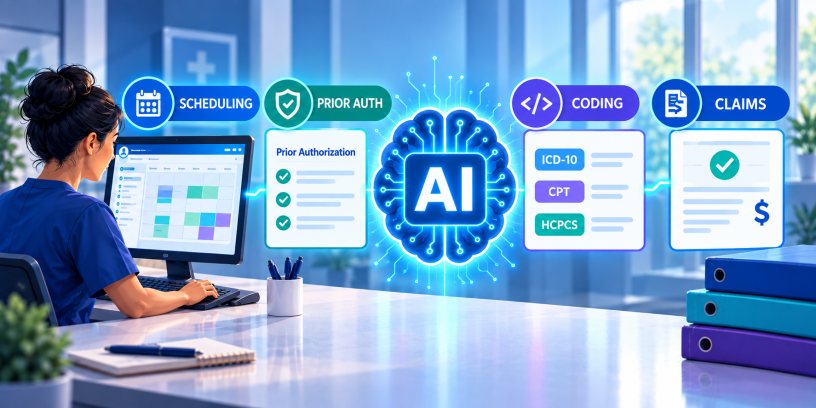
When people hear “healthcare AI” their minds often jump to high-stakes clinical models–and indeed, clinical models have immense potential to improve human health and save lives. But there is significant activity on the administrative side of health AI, too. In fact, the majority of health AI spending is for administrative applications.
This post focuses on AI for front-end and back-end revenue cycle management (RCM) in the U.S.–the administrative and financial processes necessary for healthcare organizations to get paid. As an M.D., I feel squiggly putting “revenue” and “healthcare” in the same sentence, because first and foremost I see healthcare as a human right. But I am also a realist, and in the U.S. right now, money has to change hands for people to get care. So let’s dive in to the nitty-gritty details of healthcare RCM: what it is, how it works, and how AI can help. This post may be of interest to health system leaders and private practice owners interested in streamlining RCM, as well as entrepreneurs building in this space.
What is front-end RCM?
Front-end RCM happens before and during patient care. It includes:
- Appointment scheduling: Capturing the patient’s contact information, visit reason, insurance information, appointment type, and appointment date and time.
- Patient registration: Capturing the patient’s legal name, date of birth, address, and HIPAA paperwork signatures.
- Insurance verification: Confirming that the patient’s insurance policy is active, and what it does/doesn’t cover for this visit.
- Prior authorization: Obtaining formal approval from the insurance company before delivering care.
- Point-of-service payments: Estimating out-of-pocket costs and collect payment from the patient during check-in. Payment may include copays, coinsurance, or past-due balances.
You might glance at the list above and think, “Most of this front-end stuff looks like simple form-filling or database lookups. Why would you need AI at all?” Turns out, everything in healthcare is more complicated than it first appears. In the next two sections we’ll look specifically at scheduling and prior authorization to understand how these processes work and where AI can help.
Voice agents for medical appointment scheduling
Voice agents can help with scheduling patient appointments. Why would you need a full-on voice agent instead of a Calendly link? Because medical appointment scheduling is not as simple as “book a meeting with your engineering coworker.” Why voice agents are needed:
Basic information: The scheduler needs to confirm the patient’s identity and, of course, coordinate with their availability.
Clinical triage: The scheduler needs to take into account the patient’s specific clinical situation to route them to the correct specialty, clinician, or appointment type.
Appointment types and lengths: Every medical specialty has its own quirks around what types of appointments are offered–e.g., for a primary care doctor, annual physical exam vs. new problem/acute visit vs. same-day/urgent visit vs. chronic care visit vs. hospital follow-up. These may be demarcated as separate visit types in the scheduling system and/or they may be associated with certain time intervals. It’s therefore critical that the scheduler book the patient in the right kind of slot.
Clinical instructions: The scheduler may also need to convey specific instructions like fasting before a lab draw.
Software integrations: Some practices have scheduling built directly in to their electronic health record while other practices do scheduling through a separate practice management system, so on top of all the aforementioned complexity, any automated scheduling system needs deep integrations with multiple electronic health records and practice management systems in order to serve multiple customers.
HIPAA compliance: The system handles protected health information so it needs to be HIPAA compliant.
Medical terminology: Unlike a voice agent for, say, reserving a hotel room, a medical voice agent must be able to understand and pronounce medical terminology, from lisinopril to pseudohypoparathyroidism.
Prior authorization: Sometimes prior authorization is needed to book specific medical appointments. This depends upon the patient’s insurance coverage and appointment type.
Voice agents for scheduling are built to tackle all of the above challenges while conversing in real-time with patients on the phone.
AI agents for prior authorization
What is prior authorization? It’s an administrative process whereby a clinician is required to get approval from the insurance company before a patient can have a certain medical service or treatment.
In theory, the prior authorization is meant to ensure that care is medically necessary. In practice, prior authorization has expanded over multiple decades into a burdensome administrative task. Prior authorization may be needed for hospital admission, planned surgery, imaging tests like MRIs or CTs, or medical equipment like portable oxygen tanks (Harvard)–but it also may be needed for completely ordinary care. The AMA explains, “prior authorization has deteriorated into a system that requires physicians to get the OK to prescribe even the most routine medications and procedures. It’s often even required for medications that a patient has been on for years.” To make matters even worse, prior authorizations aren’t always accepted by the insurance company: 12% of prior authorizations were denied in Medicare Advantage and 18% were denied in ACA Marketplace plans (OneMed).
Overall, the AMA found that physicians and their staff complete 39 prior authorizations per week, costing 13 hours of their time. That represents 700 hours and $34,000 per provider every year, with 40% of physicians employing staff who work exclusively on prior authorizations. 89% of physicians state that prior authorization increases burnout (AMA). Across the entire United States, prior authorizations cost $35 billion (HealthAffairs).
Wasted time, high costs, and burnout aren’t even the worst aspects of prior authorization. The prior authorization process can cause delays that seriously harm patients. Over a quarter of physicians say that prior authorization has directly led to a serious adverse event for a patient in their care, including hospitalization (23%), a life-threatening event or one that required intervention to prevent permanent damage (18%), and disability/permanent damage/death (8%) (AMA). Overall, 94% of physicians say that prior authorization negatively impacts clinical outcomes (Humata).
The prior authorization process is burdensome because of its immense variability. The prior authorization forms differ by insurance company (for example forms see here, here, and here), and there are over a thousand insurance companies in the U.S. so form fragmentation is a true administrative nightmare. The specific information needed to complete a prior authorization varies based on the details of the individual patient’s medical history and what the clinician is seeking approval for (e.g., “patient needs a prescription for Advair” vs. “patient needs a brain MRI”). The patient’s history is stored electronically in a different format depending on what electronic health record the practice or health system is using.
Because of this variability, automating prior authorization is not as simple as “autofill a form based on a database.” It’s more like, “autofill 1,000 different forms for an infinite variety of patients for 500+ electronic health record vendors for any of the 10,000+ different medications/procedures/labs that one might need to seek prior authorization for (which of course varies based on the insurance company) and also you might need to talk to someone on the phone.”
AI can help with prior authorization in different ways, e.g. by:
- Figuring out whether a prior authorization is needed and what information the insurance company wants;
- Searching the electronic medical record to find diagnoses, prior treatments, and notes that justify medical necessity;
- Logging in to insurance company portals and filling out forms. (The older version of this is RPA = robotic process automation);
- Calling insurance companies on the phone (e.g., to submit requests or check on pending requests);
- Generating and sending fax packets to insurance companies, and/or receiving/processing faxes from insurance companies;
- Detecting if a prior authorization has been denied, and automatically drafting appeal letters or preparing for peer-to-peer reviews.
Structured electronic submission channels (FHIR APIs, ANSI X12 278 transactions, and ePA networks for pharmacy) also exist which require more traditional software engineering.
Additional references for this section: here, here, and here.
What is back-end RCM?
Back-end RCM happens after patient care. It includes:
- Medical coding: Applying specific ICD-10 or CPT codes to the patient’s medical record to document what was done;
- Claim submission: Formatting the codes into clean electronic claims and sending the claims to insurance companies;
- Payment posting: Reconciling incoming insurance payments against patient accounts;
- Claim denials management: Investigating why an insurance company denied a claim, fixing the claim, and resubmitting it;
- Account receivable follow up: Tracking unpaid or late claims and communicating with insurance companies to speed up cash flow;
- Patient billing: Sending final statements to patients and collecting remaining balances from them.
For examples of AI automation in back-end RCM, we’ll hone in on medical coding and claim denials management.
AI for medical coding
Medical coding is the process of assigning alphanumeric codes to appointments or hospital visits, identifying the relevant diagnoses, procedures, medical services, and/or equipment for those encounters. It is basically “tagging” a medical encounter, where the allowed “tags” (codes) come from formal medical coding systems such as ICD-10, CPT, and HCPCS Level II.
ICD-10-CM stands for “the International Classification of Diseases, Tenth Revision, Clinical Modification.” ICD-10 codes represent diseases and medical conditions. Examples: M19.022 = Primary osteoarthritis, left elbow; T85.03 = Leakage of ventricular intracranial (communicating) shunt; A02.22 = Salmonella pneumonia.
ICD codes are organized hierarchically, so for example “A02.22 Salmonella pneumonia” is a subcategory of “A02.2 Localized salmonella infections” which is a subcategory of “A02 Other salmonella infections” which is a subcategory of “A00-A09 Intestinal infectious diseases” which is a subcategory of “A00-B99 Certain infectious and parasitic diseases.” For more details on ICD codes see this post.
CPT stands for “Current Procedural Terminology.” CPT codes describe medical services and procedures. Examples: 97110 = Therapeutic Exercises, 71045 = X-Ray Chest Exam 1 View, 90837 = Psychotherapy with Individual Patient for 60 Minutes. CPT codes are also organized hierarchically. HCPCS stands for “Healthcare Common Procedure Coding System.” HCPCS Level II codes identify procedures, supplies, and services not included in CPT codes, including prosthetics and ambulance services.
Medical coding follows detailed rules. These rules are printed in huge textbooks that are hundreds of pages long (example). To become a medical coder, a person must have a high school diploma, followed by a certificate program or associate’s degree, followed by a professional certification process.
How can AI help with medical coding? AI systems can be used to suggest codes for humans to review, code routine encounters automatically, flag places where electronic medical record documentation should be improved to support coding, or check previously-assigned codes for correctness.
From an automation standpoint, medical coding might at first appear to be a simple multilabel classification task. The input is the patient’s medical record for a specific encounter, which is a mixture of tabular and textual data. The model must predict the small set of codes (in the ballpark of 3 to 12 codes) that should be applied to the encounter. However, medical coding is far from simple for several reasons:
- The space of possible labels is massive. There are over 60,000 different codes in ICD-10 alone.
- Many codes are extremely rare and may never be seen during training.
- The output is structured and not a set, meaning the order of codes/labels matters (e.g., principal vs secondary diagnoses, primary vs secondary procedures).
- The codes are hierarchical, meaning a code might be “true” for an encounter but not the optimal level of detail.
- The codes depend on each other through explicit rules spelled out in those giant textbooks I mentioned.
- Different human coders have different tendencies (e.g., undercoding vs. upcoding), which complicates training on historical data.
- All codes must be supported by evidence in the medical record, meaning assigning a code is not enough–it must be clear what piece of the medical record supports it. Explainability and evidence retrieval are critical.
- The codes themselves and the associated coding guidelines get updated frequently.
- The electronic health record used as input is messy especially for long inpatient stays.
Because of this complexity, directly applying a general-purpose LLM to the task of medical coding results in poor performance. A study by Soroush et al. evaluated GPT-3.5, GPT-4, Gemini Pro, and Llama2-70b Chat for medical coding and found “all tested LLMs performed poorly on medical code querying, often generating codes conveying imprecise or fabricated information.” However, prompt engineering, RAG, and fine-tuning can improve performance of LLMs for medical coding, and there are numerous companies building highly specialized AI-powered solutions for autonomous or semi-autonomous medical coding.
Further section references: here, here, here, here, and here.
AI for claim denials management
That brings us to our last example–claim denial management. Insurance companies have their own systems and people in place to inspect claims, and if they find problems with a claim they will deny it. In 2025 alone, hospital claim denials resulted in $48.4 billion in lost revenue. Claim denials are on the rise: 41% of clinicians face denial rates of 10% or higher.
Because healthcare loves classification systems, there’s a whole classification system for the reasons that claims are denied. Claim Adjustment Reason Codes (CARC) explain why an insurance claim was denied or paid differently than it was billed. The top claim denial reasons along with their CARC codes are: CO-16 Missing or invalid information (20%), CO-45 Charge exceeds allowed amount (28%), CO-97 Bundled into another procedure (15%), CO-50 Not medically necessary (12%), CO-29 Timely filing limit exceeded (10%), and CO-15 Authorization not obtained (8%–this means prior authorization was missing or expired). From a conceptual standpoint, claims denials most often boil down to missing or inaccurate data, problems with prior authorization, inaccurate or incomplete patient information, coding errors, insufficient evidence in the patient’s medical record, medical necessity denials, services that aren’t covered by the patient’s specific insurance plan, and eligibility verification issues. (As you can see, there’s some overlap in front-end and back-end RCM, since improvements in prior authorization and patient information collection on the front-end can directly improve claim acceptance rates on the back-end.)
In human claims denials workflow, people need to manually review, revise, and resubmit denied claims, which is time- and labor-intensive. AI can help with claims denials in several ways. The best way to reduce denials is to prevent them in the first place. Before claim submission, AI can review claims to catch errors, identify documentation gaps, and strengthen the clinical validation and medical necessity support. After claim denial, AI can help focus resubmission efforts on claims most likely to pay. It can also automatically correct and resubmit claims for simple denials, and help draft appeal letters including following payer-specific forms. AI solutions built around claims need to be engineered carefully for regulatory compliance including making sure there aren’t violations of the False Claims Act.
Policy solutions
It’s worth pointing out that AI is not the only solution to U.S. healthcare RCM challenges. Policy changes could be even more effective for some RCM pain points.
Some Americans think that because the U.S. produces cutting-edge research in healthcare, develops novel pharmaceuticals and medical devices, and offers state-of-the-art treatments, that the U.S. healthcare system is automatically “the best in the world.” Now, as an American, I am definitely grateful for the cutting-edge healthcare that’s available here. Some of my family members’ lives were saved directly because of advanced medical care in the U.S. However, I also recognize that the best care a nation has to offer is not the only metric by which to judge its healthcare system. If we look at the entire U.S. population, the U.S. spends roughly twice as much per person on healthcare as other wealthy countries, yet has the lowest life expectancy (VisualCapitalist). Clearly there is room for improvement.
So that brings me to my final point, which is that AI is not the only solution to inefficiencies in healthcare RCM, nor is it even necessarily the optimal one. For some aspects of RCM, a much better solution would be a law/policy change that minimizes or eliminates the problem completely. For example, in France, there is no prior authorization for routine medical care or standard elective procedures. For the scenarios where prior authorization is required the process is simple, standardized, and rule-based. And if there is no response, this means the request is approved, preventing administrative bottlenecks (Dutton, Cleiss). I was not able to identify any companies offering “AI for prior authorization in France” likely because this just isn’t as much of a problem in France as it is in the U.S. Making prior authorization for routine medical care illegal in the U.S. automatically erases a big chunk of prior auth problems without any technology at all.
I also recognize that policy changes are incredibly difficult, and that people have been trying to reform U.S. healthcare legislatively for decades…So until we have relevant policy changes, AI remains the solution that’s available now, and the market is showing strong appetite for AI-powered RCM.
Side note: If you are interested in what the U.S. could learn from other countries’ health systems, I highly recommend the New York Times bestselling book, The Healing of America by T.R. Reid. You might think, “Why would I read an entire book about health systems? Isn’t that a dry, boring topic?” Well, T.R. Reid manages to make it engaging, including by weaving in a personal narrative of how he sought care for a decades-old shoulder injury across multiple countries. I read this entire book in only a couple sittings and it opened my eyes to many exciting possibilities.
Conclusion
Administrative healthcare AI is a highly active space, with many opportunities for saving time, saving money, reducing burnout, and enhancing patient care by helping patients get the care they need in a timely manner. If you’re interested in examples of the many companies working in this space, I’ve included a list after the end of this post.
Connect with me
As an independent researcher (MD + AI PhD + 7 yrs prior founder/CEO experience), I build and evaluate cutting-edge healthcare AI for startups. Contact me to learn more.
Want to be the first to hear about my articles bridging healthcare, artificial intelligence, and business—and get a free list of my favorite health AI resources? Sign up here.
About the featured image
The featured image was generated using ChatGPT.
Healthcare RCM companies
When providers want help with RCM, they sometimes build solutions themselves and other times turn to vendors. For example, among providers using AI for claims, 49% use a combination of in-house AI and vendor AI, 10% use exclusively in-house AI, and 40% use only vendor AI.
This section includes examples of health tech RCM vendors, focused on provider-facing tools. I do not get paid any money for including companies on this list. The list is meant for illustrative purposes only, is not exhaustive, and is not intended as an endorsement of any particular company, product, or service. Companies are listed alphabetically along with a line or two of marketing copy taken from their website. Some of these companies are more AI-forward than others.
Adonis: “Recover the revenue you’ve already earned. AI-powered revenue recovery technology that helps healthcare providers recover reimbursement that slips through the cracks.”
AGS Health: “Unlock the power of your revenue cycle with a streamlined solution that automates, optimizes, and forecasts your RCM workflows.”
Akasa: “Transforming your revenue cycle with generative AI. Reducing denials. Improving margins. Increasing revenue.”
Arintra: “Enterprise-grade AI for revenue assurance. An agentic platform that powers medical coding–the one place every dollar flows through–and carries that intelligence across the revenue cycle.”
Artera: “Artera’s Harmony platform is fueled by dedicated AI Service Squads, building custom agentic solutions for the way your organization actually works.”
Assort Health: “Assort’s AI voice agent for healthcare runs on a platform trained on 250M+ interactions to handle the entire patient journey, from referrals and scheduling to intake and follow-up.”
Availity: “Fix prior authorizations: faster, smarter, and CMS-ready. Availity AuthAI combines transparent, responsible AI with the nation’s most powerful network of health plans, providers, and HITs to reduce administrative waste without compromising care.”
CodaMetrix: “CodaMetrix brings that full care journey into view–a complete timeline across days, providers, and settings–then codes and bills it, touchlessly.”
CombineHealth: “Intelligence that powers healthcare revenue. AI employees built for coding, claim management and denial management workflows–working alongside your team to deliver cleaner claims, fewer denials, and faster reimbursement.”
Commure: “The AI-native enterprise RCM and ambient platform. Turn labor into software with AI-powered intake, documentation, coding, claims, and payment solutions.”
Confido Health: “Reimagining Healthcare Operations with AI. Our AI Agents save your staff at least 2 hours every day by handling routine tasks and giving your team more time to focus on patient care.”
Elise AI: “EliseAI’s VoiceAI answers calls, schedules appointments, and manages follow-ups 24/7. Fully automate non-clinical tasks. Empowering healthcare providers to automate patient interactions and administrative tasks.”
Epic (Penny): “Penny for revenue cycle and operations. Penny automates routine tasks, surfaces data, and assists your operations with complex tasks, helping you optimize workflows and improve cash flow.”
Experian Health: “Transform your healthcare revenue cycle. Reduce denials, accelerate reimbursements and improve patient experiences.”
Flexbone: “AI agents that run your prior authorization workflow end-to-end.”
Forus: “Accelerating medicine for the people. Forus automates every step from prescription to affordable access, so patients can start therapy faster–all for free.”
HelloPatient: “Talk to every patient without hiring more staff. Our AI agents pick up every call, text, and chat, so no patient waits and no one burns out.”
Hippocratic AI: “Safest clinical voice AI for healthcare.”
Hyro: “Shield your staff from repetitive calls and messages, improve patient support and access to services, and stretch operational dollars with AI-powered agents.”
Infinitus: “Infinitus handles the communication and coordination that sits between a patient and the care they need–from first contact to long-term adherence.”
Infinx: “Heal revenue pain with AI and RCM experts. Increase revenue, reduce cost to collect, and improve cash flow with AI agent and RCM experts working together across your existing workflows and systems.”
Innovaccer: “Offers provider organizations, ACOs, and specialty providers a comprehensive suite of solutions to maximize performance in value-based care, drive patient volume growth, and reduce the administrative burden on healthcare providers.”
LatentHealth: “Intelligence that brings life-changing therapies to the people who need them. Latent simplifies the journey to health, from identifying conditions to accessing care to the final day of treatment.”
Luma: “Luma removes bottlenecks and friction from patient journeys–on both the front end and the back end. That means fewer delays and better outcomes. Operational AI across four core areas of care: access, engagement, intake, payments.”
Mandolin: “Precision automation for specialty drugs. Mandolin replaces fragmented workflows with AI agents that execute the end-to-end lifecycle, including intake, benefits, prior authorizations, and revenue cycle management.”
Prosper: “AI voice agents for patient access and RCM. Prosper AI’s voice agents handle both patient and payor phone calls, including scheduling, benefits, and patient billing.”
R1 RCM: “The healthcare revenue OS for real-time adjudication.”
RapidClaims: “Capture every dollar of earned revenue. Autonomous agents that code charts, improve documentation, prevent denials, and recover revenue with full compliance and control.”
Relatient: “Answer every patient call with a HITRUST and SOC2 certified voice AI solution that follows your provider rules and delivers accurate, efficient appointment management with zero staff intervention.”
Rhyme: “Eliminating prior auth. We start by making existing prior authorizations fully touchless.”
Silna: “Silna handles all prior authorizations, benefit checks and insurance monitoring upfront to make sure your patients are clear to receive care, and you have more capacity to provide it.”
SmarterDx: “SmarterDx analyzes the full clinical record, connects evidence across the revenue cycle, and surfaces opportunities your teams can validate and defend.”
Squad Health: “Hang up the phone. Ditch the forms. Focus on patients. Get patients on therapy faster with AI that speeds up benefits, prior authorizations, and patient assistance. Every drug, every payer–free for providers.”
SSI Healthcare Revenue Cycle Solutions: “SSI provides AI and automation-driven solutions to improve speed, accuracy, and financial outcomes for healthcare organizations.”
Superdial: “Voice AI agents for enterprise revenue cycle teams. SuperDial deploys voice-first agents that work across every payer interface–phone, portals, APIs, and EDI–to continuously retrieve and verify the data revenue cycle teams depend on.”
Tandem: “Restoring presence. The AI solution built and led by clinicians, working in tandem with Europe’s leading care providers.”
Tennr: “Move patients forward. Tennr is an agentic patient orchestration platform built for policy-grade decisioning and patient flow at scale.”
Valerie Health: “Grow your practice, not your workload. Engage more patients, unlock efficiencies, and deliver better care with an AI growth partner.”
Waystar: “Simplify healthcare payments. AI-powered software. Elevate productivity + precision. Reach new heights with Waystar AltitudeAI”
Zocdoc: “Meet Zo, the AI Phone Assistant for healthcare. Eliminate patient wait times and abandoned calls, freeing up staff and helping you schedule more appointments over the phone.”

