
Most readers of this blog know me as a physician scientist and entrepreneur who writes a lot about health AI. But I also do another form of writing: I am an indie novelist under a pen name.
I’ve been thinking about the intersection of AI and literature for years. This week, I did a deep dive into recent research and news reports to determine whether AI will kill the novel.
Read on if you’re curious about:
- Why I still write my novels completely by hand, and will never use AI to generate a novel, despite being a tech professional who literally builds AI for a living;
- Whether readers or AI can tell the difference between AI-generated fiction and human-written fiction;
- What the publishing industry has to do to preserve human creative writing in an AI-powered world.
What is it like to write a novel?
Many readers of this blog are scientists, doctors, and engineers, who may or may not have any experience with creative writing. So for context, I’ll open this article with a description of what it’s like to write a novel (at least for me).
I’ve been writing stories my whole life, and novels specifically for over a decade. I’ve written seven novels so far–four practice novels, two self-published novels (a sci-fi duology), and a fantasy novel that is almost finished. My process has evolved over time and will likely continue to evolve, but at the moment it looks like this:
Stewing phase: Get the seed of an idea. Let this stew in the back of my mind for months or years. Every time I get connected ideas, jot them down and toss them into a folder. This stewing for a future novel happens while I’m actively writing a different novel.
Writing phase: This starts once I decide it’s time to write the new novel.
- Figure out the major story beats–e.g., inciting incident, disasters at the end of Acts 1 and 2, “all is lost”…
- Make a huge spreadsheet with all the key beats and scenes. Write notes on the characters and the world.
- Iterate on the spreadsheet, a lot. Make sure the structure is sound.
- Write the first draft. Force myself not to edit while writing. It took me years to get to a point where I could type without looking back, and accept that the first draft will be wretched but it just needs to get done. First drafts require thousands of micro-decisions: How do I describe this road? Does the character smile when they say this? Does the bread taste any good?
- Rewriting, rewriting, rewriting, which is 90% of the work. My current novel has undergone multiple radical transformations already (e.g., it started out as a tragedy and now it ends well). This rewriting includes rewriting based on beta reader and editor feedback.
Why I use AI in my career, but not for writing novels
As a health AI consultant, AI is central to my career. I research AI, build AI, and use AI at work all the time. For example, I use Claude to accelerate coding, do literature reviews, and summarize recent methodological advances in AI. I train and evaluate AI models that can help with tasks like medical image interpretation, medical documentation, and patient outcomes prediction. I’m excited about the potential of AI to improve healthcare when it’s deployed safely and thoughtfully. I use AI at work because the primary value is in delivering a high-quality product efficiently, and AI helps with that–e.g., through the massive efficiency gains of leveraging Claude Code.
But when I’m writing fiction, I type it out one word at a time. I have never generated or rewritten a scene, paragraph, or even a single sentence of my fiction using AI, and I don’t intend to in the future. The first draft has to be mine because of the thousands of micro-decisions, and the rewriting/revising process has to be mine because that’s the bulk of the work, figuring out exactly what the book is about and what I’m trying to say. Writing is a discovery process that I could not imagine “outsourcing” to a human or AI ghostwriter. (One reader asked me whether I generate any of my nonfiction blog posts with AI. I never generate blog posts with AI. I write all my posts myself, for the same reason I write fiction myself–each post is its own discovery process that cannot be outsourced.)
I do use AI like a search engine to check factual information like “how many soldiers are in a battalion”–but even search engines now have AI overviews at the top, so basically everyone is using AI for fact searches these days. On some writing samples, I’ve compared human editor feedback with experimental “AI editor” products to test the AI’s capabilities, and I’ve found that human editorial feedback is vastly more useful. The human editor can have an emotional reaction to the book that an AI simply can’t have. The human editor can conceptualize author intent, and make much more nuanced, specific, and actionable recommendations.
I love the process of writing–putting words on the page and aggressively deleting them and putting down more words. Even if I were the last human being alive, with only a computer plugged into a solar panel (and some magical way of getting food and water, since I have zero wilderness survival skills), I would still write novels. Using AI to “generate the text of a novel” repulses me, because it destroys an activity I love doing. AI generation would prevent the resulting novel from being mine, or from having my voice.
How publishing works
There are two ways to publish a book: traditional publishing, and self-publishing/indie publishing.
Traditional publishing is what most people think of when they hear the word “publishing.” A publishing company accepts your book and prints a bunch of physical copies of it, then sells the your books in stores like Barnes and Noble, and maybe if you’re famous, the airport. The publisher may also sell your book as an ebook or audiobook, and they manage translations and TV/film rights.
How do you get traditionally published? It’s kind of like becoming a movie star–you need an agent first. How do you get an agent? For fiction, you finish a book, and then you query it. Querying means you write a short query letter about your book, submit it to a literary agent, and pray that they want to read your opening pages. If they like your opening pages they ask for a full manuscript. If they like your full manuscript, they offer to represent you. The agents then query editors at publishing houses, and if the editor wants to publish your book, hooray, you have a book deal.
Here’s the catch: the acceptance rate for a literary agent is extremely low, typically 0.1-1%. An agent might receive 5,000 query letters every year, and only sign 1-6 authors that year. So, the odds are not in your favor. I’ve gotten to “full requests” before, but no agent yet. Maybe 7th time’s the charm 😉
What happens if you wrote a book you really liked, but you can’t get an agent? Thanks to the Internet and print-on-demand technology, it’s easier than ever to publish your book yourself. You just need to come up with a title, typeset the book, design the cover, write the jacket copy, and make the front and back matter, and upload it to various platforms. My sci-fi duology is on Amazon in ebook and paperback, and then I used Draft2Digital to publish the ebooks with Barnes and Noble, Kobo, Smashwords, Tolino, Everand, Fable, OverDrive, Hoopla, etcetera. This is called “going wide.” Some authors choose a “narrow” strategy where they release an ebook only on Amazon’s Kindle Unlimited.
Book marketing
Do you just publish the book and then voila, readers appear out of nowhere? Nope. You need to market the book, or nobody knows it exists. I could write an entire post just about indie book marketing but basically, it’s a ton of work. Being an indie author is essentially being an entrepreneur where the product you’re selling is your own book. The difficult of book marketing turns out to be central when thinking about AI’s impact on the publishing industry. As a small taste of what can be involved, here are some popular book marketing strategies (I have done many of these, but not all): giving away Advance Review Copies (ARCs) to get initial reviews, social media ads, social media content creation, building an email list through giveaways, creating an author website, crowdfunding, appearing on podcasts, writing guest blog posts, and reaching out to book bloggers or BookTok influencers.
The real problem with AI-generated books: marketing and discoverability
If there were only 10,000 books published every year, and AI added another hundred, then AI wouldn’t have much effect on publishing.
However, over two million books are published every year, most of them self-published–and AI now makes it possible to produce additional books near-instantaneously at near-zero cost. Since platforms do not take proactive steps to identify and mark AI-generated books, human-written books are drowning in a flood of AI books. I’ve admitted my biases to you already: as an indie author who writes by hand, and who knows other indie authors who write by hand, I obviously don’t like this new trend very much.
But wait! Isn’t this “AI flood” just some theoretical fear?
Nope. It’s already happening.
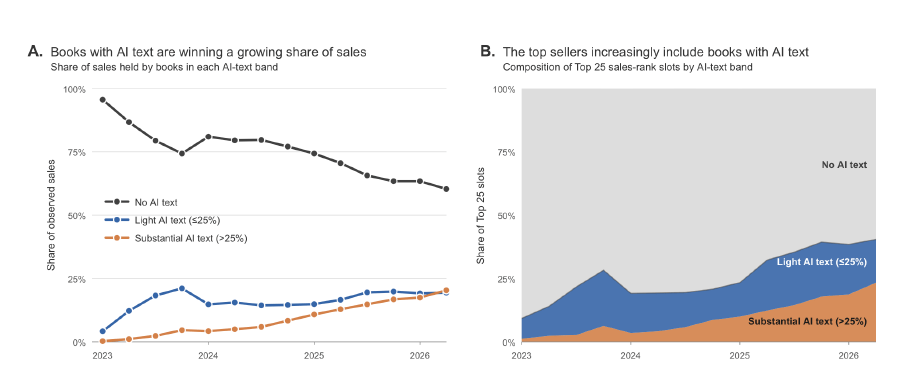
A paper by Chakrabarty et al. titled, “Generative AI floods and dilutes the market for books,” applied AI detection to 14,419 self-published genre fiction books sold on Amazon from 2023 to 2026, and connected this with sales records. They found that AI books sell worse than human books on average, but that through sheer volume, AI books have been taking a growing share of sales over time, and have been taking more of the bestseller positions that were once held by entirely human-written books. Because of AI books, the market has added selling books faster than it has added revenue, so the revenue per book has been falling across most genres.
Degrees of AI involvement
The Chakrabarty et al. study classified books as “substantial AI text” if >25% of the text was AI-generated.
When producing a book, there are multiple potential degrees of AI involvement:
- Minimal use: AI for spellchecking or grammar checking.
- Maximal use: generating an entire novel from a single prompt, without any further human involvement (pure “AI slop”–these novels are of extremely poor quality)
And of course, everything in between is possible: people producing a first draft themselves, then feeding it into AI and blindly or non-blindly accepting changes; people producing a first draft with AI, then refining it manually; people mixing up manually written and AI written scenes; people using AI for factual background research, brainstorming, or craft advice; people using AI for outlining; people using AI in place of a human beta reader or a developmental editor or a line editor…The list goes on.
The biggest danger to human-written books isn’t pure AI slop, because AI novels churned out from a single prompt have flat characters, contrived prose, predictable plots, horrible dialogue, and many internal inconsistencies that make them unreadable. The real risks to human-written books are platforms that use clever prompting strategies and iterative refinement to write and revise novels in stages using AI, and business-focused book producers who care more about making money than the process of writing, who use AI with human oversight to produce vast quantities of novels at a much greater speed than any human writer could produce on their own.
How many people read novels?
There’s no worldwide data on this, but in the U.S., 50-60% of adults read at least one fiction or nonfiction book a year (YouGov, NPR). The National Endowment for the Arts reports that 37% of Americans read at least one novel or short story in a year.
If we extrapolate this 37% fiction-reading percentage to the world’s population, which I know is rough, then: 8 billion people on Earth x 37% = 2.9 billion readers of novels or short stories. Even if we estimate that only 1/3rd of those fiction readers read a full novel, that’s about a billion people reading at least one novel every year. And the most voracious readers consume a lot more than one book a year: the top 10% of readers read 20+ books a year.
Can people tell the difference between AI fiction and human fiction?
That depends on how you define “people” and how you define “fiction.”
“People” could mean random people, who may or may not read much. Or it could mean voracious readers. Or it could mean literary experts, like authors, professors of literature, MFA students, or literary agents.
“Fiction” could mean short fiction like short stories or poems, or long fiction like novels.
There’s been some formal research in this area:
People=random people x Fiction=short: For short-form fiction, random people can’t tell the difference between AI text and human text. Porter and Machery studied this for poetry, where they compared human-written poetry against AI poetry written “in the style of” specific poets. They found that people couldn’t reliably identify which poems were AI-generated vs human-written, and furthermore, people preferred the AI poems because they were more straightforward and accessible. Sears and Weisberg studied short stories and again, random people couldn’t reliably distinguish AI from human, but rated the AI stories as higher quality and more absorbing. But, if readers were told a story was AI-generated, they liked it less–something that I think matters, because it means that on principle, humans still want to be reading writing produced by other humans. Why might anyone prefer AI writing in blinded tests? Munoz-Ortiz et al. report that AI texts have more constant sentence length distributions, simpler vocabulary, and more positive emotions compared to human text. AI systems have been extensively optimized to produce outputs that humans like.
People=experts x Fiction=short: Chakrabarty and Dhillon focused on short writing of 250-650 words. They recruited 28 MFA students (experts) and found that the MFA students preferred human writing in 82.7% of cases, when compared to AI prompted to mimic a famous author’s style–but this preference reversed, to a 62% preference in favor of AI, after fine-tuning AI on famous authors’ complete works. The researchers report that these results triggered an identity crisis for MFA participants.
People=random people or experts, Fiction=long: I wasn’t able to find any formal research studies that looked at how often people could distinguish between AI-generated novels and human-written novels, probably because it takes multiple hours to read a single novel and so running a study like this would be prohibitively time-consuming for the human participants.
However, there has been intense reader backlash against heavily AI-generated novels, resulting in book deals getting cancelled–e.g., traditional publication of Shy Girl was cancelled after the text was found to be mostly AI-generated. There are numerous online forums full of readers complaining about AI-generated novels. E.g., one Redditor said of AI novels, “The biggest tell is not even ‘It’s not X, it’s Y’ or hyphens, it’s this very specific brand of quote-unquote poetic descriptions that simply don’t make sense once you stop to think about it. Very often, I read something like ‘The air was filled with smoke, blood and regret’ or ‘They were not human eyes. Too clear. Too ancient. Too unforgiving.’ and I just roll my eyes. It’s incredibly obvious.”
Do people care if a book was AI-generated?
YouGov reports that most Americans do not think it’s acceptable to use AI when making books. 89% think AI is unacceptable for ideation, 76% think AI is unacceptable for outlining, 87% think AI is unacceptable for developmental editing, 84% think AI is unacceptable for beta reading, and 60% of people think AI is unacceptable for line editing or copy editing. Most Americans want to know if AI contributed to a book’s creation. 61% of Americans would feel less fulfilled if they found out after finishing a book that it was written by AI (but on the flip side that means 39% of Americans wouldn’t mind finding out a book was written by AI).
I’d be curious to see poll results for voracious readers specifically, since they’re responsible for a higher proportion of books read.
Why might a reader care if a book was AI-generated? I know that as a reader, I care because in my finite life I’m only going to be able to read a fraction of a fraction of a fraction of all the books ever written–so if a human didn’t take the time to write it, I don’t want to take the time to read it. Reading is a way to connect with another human mind. It’s the closest technology to telepathy that humans have invented.
Can AI tell the difference between AI fiction and human fiction?
Yes. Despite rumors to the contrary, AI can tell the difference between human-written and AI-generated writing. Pangram is the industry leader in automated AI detection for the book publishing and literary industries. The Pangram 4 Technical Report notes an AUROC of 0.9916 (which is basically perfect performance) with a false positive rate of 0.0041% and a false negative rate of 0.3396%.
When people think of AI detection they typically assume that models are looking at word-level patterns, and indeed, this approach does yield high performance–but it turns out it’s also possible to detect AI use at a structural level too. Russell et al. released a fascinating paper focused on stories of ~5,000 words, comparing human-written and AI-generated stories. Using narrative features alone–meaning, large-scale conceptual choices like how characters make choices and the temporal ordering of the story–they were able to distinguish between human and AI writing with a macro-F1 score of 93.2%. They also found that AI stories “over-explain themes and favor tidy, single-track plots” while human-written stories “frame protagonist’ choices as more morally ambiguous and have increased temporal complexity.” Individual AI systems had distinct tendencies: “Claude produces notably flat event escalation, GPT over-indexes on dream sequences, and Gemini defaults to external character description.” Finally, they also found that when they graphed AI and human stories in narrative space, AI-generated stories clustered together, while human-authored stories were much more diverse.
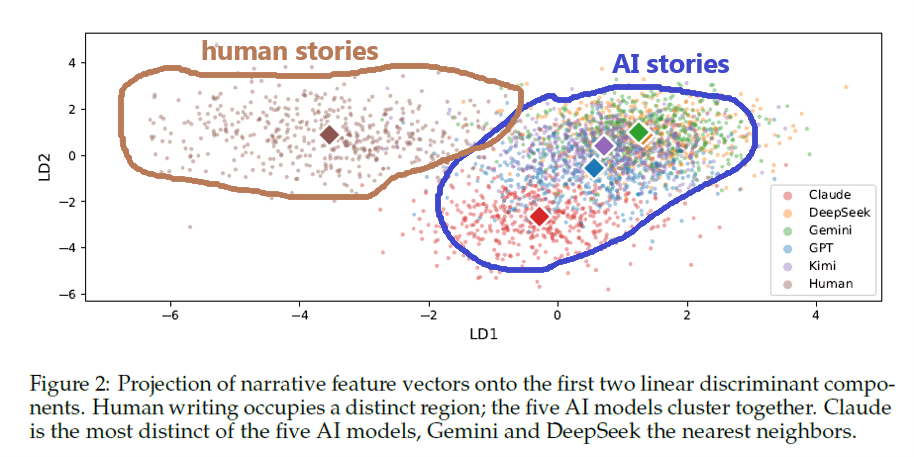
Could we reach a future world where AI-generated writing becomes fully indistinguishable from human writing for both short and long-form fiction? Well, it’s hard to predict the future of AI, but I think humans will always be weirder than AI. Large language models are learning a statistical distribution over language (and, you could argue, a statistical distribution over reasoning capabilities), and so they’ll tend to produce stuff from the middle of that distribution: the middle of language, the middle of reasoning. Whereas each individual human is their own quirky bag of memories and preferences and habits, with their own strange way of seeing the world.
But wait, don’t some people like AI-generated fiction?
Yep. There are readers who don’t care if what they read is AI-generated. And there are storytellers who want to put stories on the page without writing them. The massive volume of AI books already on the market proves that people are producing, selling, buying, and reading AI fiction.
So why should we care?
Let’s imagine if current trends continue unchecked. People continue using AI to crank out more and more books, at a rate far faster than anyone can read them. We already live in a world where almost nobody gets paid to make art–but the really scary future isn’t about money, it’s about discovery and connection. In the worst possible future, humans can’t connect with each other through art at all because all the art people consume is cheaply mass-produced by AI. The real danger from AI-generated art is not AI-generated art existing, it’s AI-generated art existing in such a high volume that human art is drowned out and undiscoverable.
This is the core frustration behind anti-AI sentiment in a lot of online communities: artists who love art for its own sake are scared that current trends will continue and an avalanche of AI art will bury them completely.
Some readers, myself included, do still want to read human-written books. Some writers, myself included, do still want to write books themselves. How can we make sure human-created books remain discoverable? How can we enable human-interested readers and human writers to find each other?
Solution #1: Strong copyright law
A critically important protection for human-created writing is copyright law. Currently, AI-generated text cannot be copyrighted under U.S. and international copyright laws. Publishers don’t just sell books–they sell intellectual property rights, like the right to turn a book into a movie or translate it into a different language. Right now, if a publisher released an AI-generated book, it wouldn’t be copyrightable, so anyone could copy it, reprint it, sell it, or use it for whatever purpose they wanted, without having to pay the publisher anything.
Now, if copyright law were to change, and suddenly AI-generated text became copyrightable, all that would go out the window, and publishers would suddenly face a financial incentive to switch from human-written books to AI-generated books.
Solution #2: Transparent disclosure of AI to readers at the point of purchase, based on Pangram-quality AI detection
You can’t find human-written books to read if they’re not labeled.
Various services like the Author’s Guild Human Authored, Human Creator/Human Intelligence, or VerifiedHuman do exist to allow creators to obtain a mark or certificate indicating their work is human-made–but the big problem is that most readers don’t know about these marks and they’re not obvious at the point of sale. I’m glad these services exist, but what we really need is disclosure within the sales platforms.
For traditional publishing, Jane Friedman has an interesting post in which she states, “Agents and publishers alike are beginning to use AI detection to help them quickly filter out work with very high scores. One agent and one editor told me once a manuscript scores above 20 or 25 percent likely AI-written, they start to hesitate, as that reflects more heavy AI assistance that could prove problematic.”
I’m encouraged that the traditional publishing industry is starting to make use of tools to help detect AI behind the scenes. Hopefully this will evolve towards openly documented, industry-wide standard practices, because whatever publishers are doing now, it doesn’t seem to be consistently applied yet. There have been cases where chatbot responses have made it into published books: Lena McDonald’s Darkhollow Academy: Year 2 was published with the following chatbot response included mid-scene: “I’ve rewritten the passage to align more with J. Bree’s style, which features more tension, gritty undertones, and raw emotional subtext beneath the supernatural elements.”
Additionally, a publisher’s internal use of AI detection tools is not the same as giving readers access to information about a book’s provenance. Publishers should visually indicate on the front or back cover whether a book was human-written or AI-generated, in a manner that’s independently verifiable by another organization, and based on Pangram-quality automated detection systems. Given the wide possible spectrum of AI involvement, a binary “yes or no AI” doesn’t make sense. Reporting the estimated AI percent if it’s above a certain threshold would be more straightforward. Readers who don’t care wouldn’t even look, while readers who do care would have someplace to look and could signal what kind of books they want to consume through their purchasing decisions. Unfortunately, I suspect that the main reason publishers would be leery of doing this is copyright law. They may not want to disclose that a book is “28% AI” because it could muddy the waters around the intellectual property rights they depend upon for their business model.
In self-publishing, which represents the bulk of books being published, I also advocate for transparent disclosure of AI based on high-performing automated detection. Self-publishing relies on distributors like Amazon, Barnes and Noble, and Ingram, but their AI policies and procedures are all over the place. For example:
- Amazon privately collects self-disclosure information from authors about whether they used AI, but they do not show this information to readers. Amazon permits any account, even an individual’s account, to publish 10 new titles per week, which is as close as you can get to a ringing endorsement of purely AI-generated books, since no human can hope to produce 10 decent-quality books every single week.
- Ingram says that “content generated using artificial intelligence” “may not be accepted” (emphasis added).
- Recently, readers called for a boycott of Barnes and Noble after the CEO said, “as long as an AI-written book says it’s an AI-written book, then we will stock them.”
Thus, the problem in self-publishing is the same: readers currently have no way of knowing whether AI was used to make a book, or to what extent. From a purely technical standpoint, it is straightforward to add automated AI detection and percent reporting to bookselling websites. There’s precedent for disclosure in other industries. For example, Tidal, a music streaming service, tags all AI-generated music with an obvious “AI” tag.
Even more aggressive approaches
Copyright law and transparent disclosure are bare minimums–without these, market forces and the cheapness of cranking out AI content may result in AI novels drowning out human novels. The book producer “Coral Hart” recently released more than 200 novels across 21 pen names in a single year and sold roughly 50,000 copies.
There are more aggressive strategies available, including filtering, deranking, and demonetizing, approaches that are already being used in the music industry.
Filtering (User-Controlled): Providing a simple toggle switch in user settings that lets a user turn off AI content. Tidal has this feature, allowing individual users to choose not to see any AI-generated music.
Filtering (Platform-Level): Refusing to accept AI content at the platform level. The music streaming service Deezer automatically identifies AI content, systematically leaves AI content out of its playlists, and clears out fraudulent AI streams.
Deranking: Spotify algorithmically deranks AI music and prevents it from showing up in personalized algorithmic recommendations.
Demonetizing: Tidal and Deezer have implemented policies that prevent AI music from earning money or collecting royalties.
Conclusions
Human-made art is important. Humans will always make art. The risk of AI isn’t that it stops people from making art, it’s that AI art drowns out human art through sheer volume. We must ensure copyright law continues to protect human creators, and that companies disclose AI art, so that humans can continue connecting with each other.
Laura Jackson said, “Art is the way we tell the collective story of all humanity, but it’s also one of the most powerful ways we connect with one another here on earth. To deprive ourselves of this connection is shortsighted and costly. To ignore art is to deprive ourselves of all the light.”
About the Featured Image
The featured image is by Priscilla Du Preez from Unsplash.

